The largest island
At about 430 km² Naxos is bigger than Mykonos, Paros and Ios combined. That scale is why one week never feels repetitive — and why a vehicle changes the whole trip.

The largest island in the Cyclades is also its most self-sufficient: marble mountain villages, the best sand in the Aegean, and a green interior that still farms, herds and makes its own cheese. Here is how to see all of it.
Naxos grew fertile before it grew touristic. It has water, farmland and marble, which meant it never depended on visitors to survive — and that is exactly why it still feels like somewhere people actually live.
At about 430 km² Naxos is bigger than Mykonos, Paros and Ios combined. That scale is why one week never feels repetitive — and why a vehicle changes the whole trip.
Half the island's economy is still agriculture. Villages like Filoti and Koronos are lived-in rather than curated, and prices in the tavernas reflect that.
A near-continuous ribbon of pale sand runs down the west coast, from organised Agios Prokopios to the cedar dunes of Alyko. Shallow, clear and genuinely swimmable.
Apeiranthos is built entirely of marble. Halki was the island's commercial capital. The interior is a second holiday hiding behind the first one.
Naxos has a long, generous season. The question is less about weather than about what you want the trip to be — a beach holiday, a walking and driving holiday, or something in between.
| Season | Weather | Crowds | Prices | Best for |
|---|---|---|---|---|
| Spring Apr–May |
18–24°C, green hills, wildflowers | Very low | Lowest | Hiking Zas, the Tragaea valley, driving with empty roads |
| Early summer June |
26–30°C, sea warm from mid-month | Moderate | Mid | The best all-round month: beaches plus comfortable village days |
| High summer Jul–Aug |
30–35°C, strong meltemi wind | Peak, especially mid-August | Highest — book vehicles early | Watersports, nightlife, guaranteed heat |
| Autumn Sep–Oct |
24–29°C, warmest sea of the year | Falling through September | Mid, dropping fast in October | Swimming without crowds, harvest food, golden light |
| Winter Nov–Mar |
10–17°C, rain, snow on Zas peaks | None | Minimal, but limited openings | Village life, festivals, walking — not a beach trip |
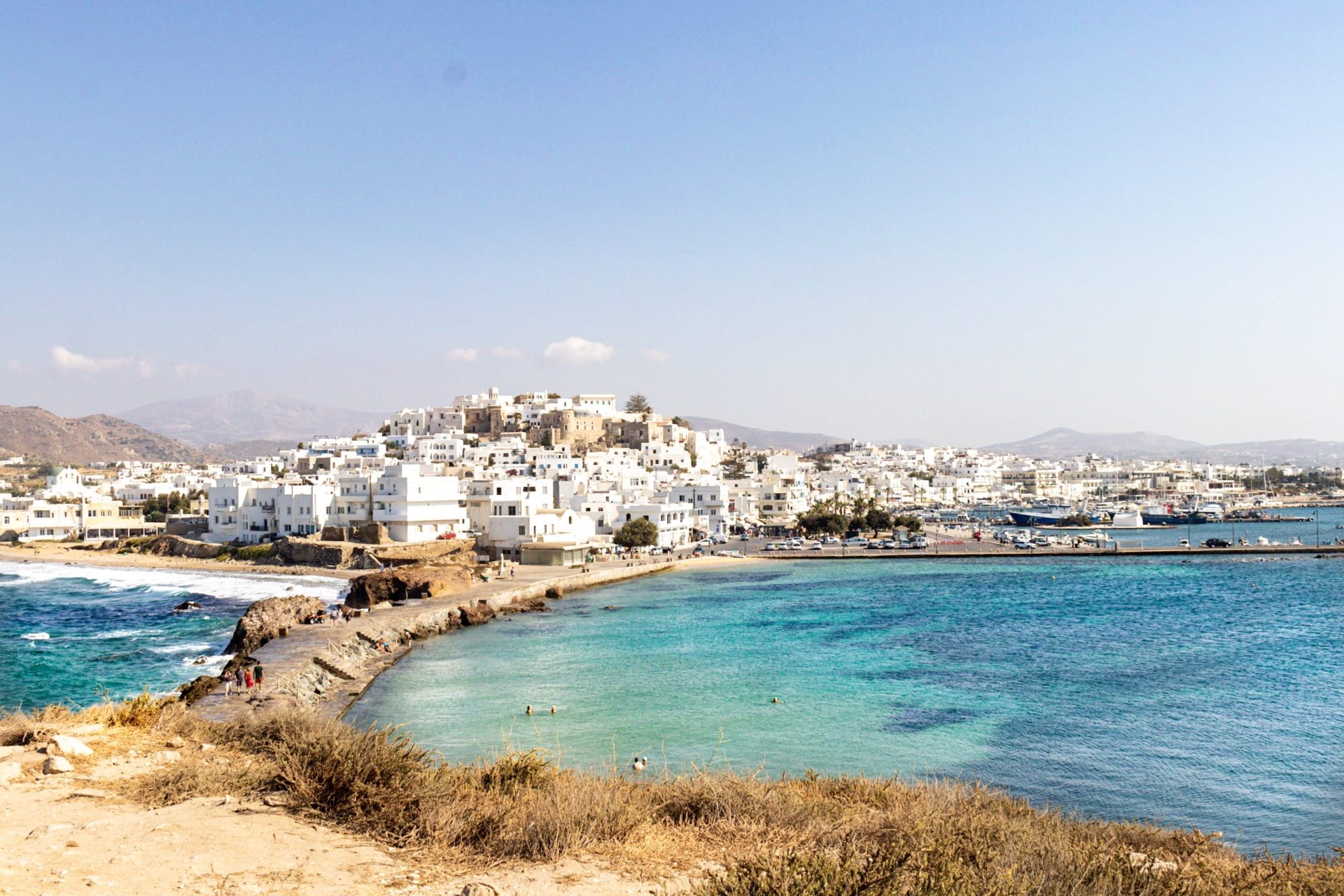 Ferries dock in the heart of Chora
By ferry. Naxos is one of the best-connected islands in the Cyclades. High-speed boats from Piraeus (Athens) take roughly 3–4 hours; conventional ferries take 5–6 hours and cost considerably less. Frequent hops link Naxos with Paros, Mykonos, Santorini and Ios, which makes island-chaining straightforward.
By air. Naxos Airport (JNX) sits three kilometres south of Chora and handles small domestic aircraft from Athens in around 40 minutes. Capacity is limited, so seats sell out well ahead in summer. Many visitors fly into Mykonos or Santorini and take the ferry across instead.
Once you land. Buses run from Chora to the main west-coast resorts and to a few large villages, several times a day in season. They are cheap and useful for a beach day at Agios Prokopios. They will not, however, get you to Alyko at sunset, to the kouros at Melanes, or up to Koronos and back in an afternoon — and they stop early.
Naxos rewards the traveller who can turn off the main road on impulse. That is the practical case for having your own vehicle here, and it is covered in full on our guide to renting a car in Naxos.
Vehicles are the first thing to sell out in July and August. Compare 13+ local Naxos rental companies in one place, with real availability.
Think of Naxos as four distinct trips stacked on top of each other. Most visitors only ever unlock the first one.

The port town, the Venetian castle quarter and the Portara on its islet. Walkable, atmospheric after dark, and the base most people choose.

Apeiranthos, Koronos, Filoti. Marble lanes, emery mines, cold spring water and the slowest afternoons on the island.

Plaka, Mikri Vigla, Kastraki, Alyko. Kilometres of sand, kitesurf launches and the wildest, emptiest stretches of shoreline.

An inland valley of olive groves, Byzantine chapels and the old kitron distillery. Green, shaded and unexpectedly cool in August.


Fifteen beaches, ranked by what they are actually good at — families, wind, seclusion or a beach bar until sundown. Read the beach guide.
Eight routes across the island with real distances, timings and the stops worth pulling over for. See the driving routes.
The Portara, the kouroi, Venetian towers and the Zas trail, village by village. See things to do.

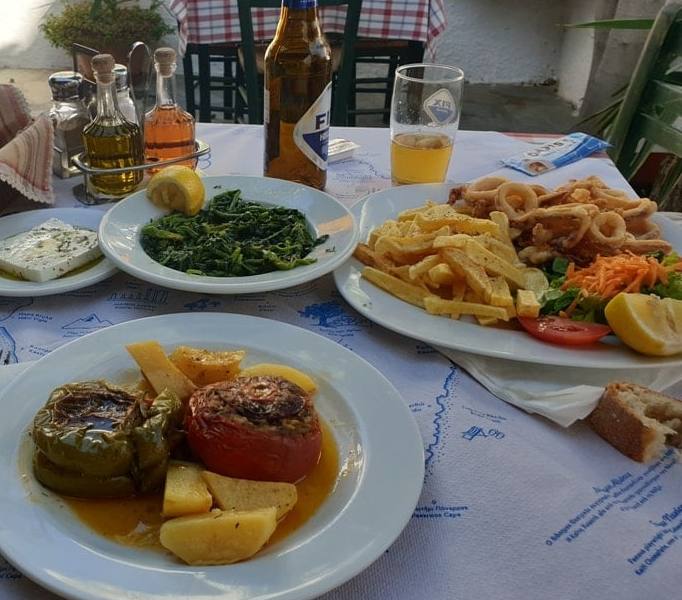
Naxos is the agricultural heart of the Cyclades, and its menus prove it. Start with graviera, the island's protected hard cheese — nutty, slightly sweet, made from a blend of cow and sheep milk and sold everywhere from village co-operatives to the supermarket in Chora.
Then there are the famous Naxian potatoes, grown in the sandy plains behind the west coast and treated with genuine local pride. Order them fried at a taverna and you will understand the fuss. Meat matters here too: unlike most Cycladic islands, Naxos has grazing land, so veal and goat appear on menus that elsewhere would be all fish.
Finish with kitron, a citrus-leaf liqueur distilled in Halki since 1896 and produced nowhere else in the world. It comes in three strengths, colour-coded green, yellow and clear. The green is the sweetest and the easiest introduction.
Eat late. Nothing gets busy before nine, and the best village tavernas — in Filoti, Halki, Apeiranthos and Moutsouna — are exactly the ones you need a vehicle to reach.


Cars, scooters, quads and buggies from local Naxos companies — compared side by side, with live availability.
Five to seven days is the sweet spot. Three days covers Chora and the west coast beaches only. With five you can add the mountain villages, the Tragaea valley and the drive north to Apollonas. A week lets you slow down, repeat a favourite beach and still see the interior properly.
It is a different kind of trip. Santorini sells the caldera view and Mykonos sells nightlife, both at premium prices. Naxos is far larger, considerably cheaper, has much better sand beaches and a working agricultural interior, so it feels like a real island rather than a resort. Travellers who want beaches, villages and food over scenery-queues usually prefer Naxos.
If you plan to leave Chora and Agios Prokopios, yes. Naxos is roughly 430 square kilometres and the bus network serves only the main coastal resorts and a handful of large villages, with a few departures a day. Beaches such as Alyko, sites such as the Melanes kouros and most mountain villages are realistically only reachable with a rented car, scooter or quad. Our full explanation of renting in Naxos covers the trade-offs.
Very. The west coast beaches — Agios Prokopios, Agia Anna and Plaka — have shallow, gently shelving water, soft sand and organised facilities within walking distance of family accommodation. Distances are short, food is unfussy and inexpensive, and the island has a relaxed, low-key atmosphere compared with the party islands.
June and September. Both give you reliably warm sea temperatures and long days without the August crowds or peak pricing. May and early October are excellent for walking, driving and village exploring, though the meltemi wind and cooler evenings mean fewer full beach days.
Every beach, village and route in this guide is easier — and several are only possible — with your own wheels. Compare cars, scooters, quads and buggies from 13+ local Naxos rental companies in one place.
Compare all Naxos rental companies